Wednesday, 18 April 2018

Shakespeare's Othello character's

Shakespeare's Othello character's 

Othello 
In the beginning of the play he is represented as a noble character whose respected as a war hero, However by the end he turns into an irrational, violent and jealous husband whose insanity and guilt for the murder of his wife drives him to commit suicide. Othello is from north america, he’s obsessed with self image and all the prejudice he has to face and overcome, that is why in the end  he is led to believe that his wife has been cheating on him.
During Shakespeare’s era the first person to play Othello was Richard Burbage, this is because he was a good friend of Shakespeare as well as being an actor and business partner, he was one of the most successful actors from The Globe. Also because there was a lot of segregation they couldn't have a black actor so Richard Burbage was painted black
Desdemona 
Desdemona, she was the main female protagonist of Othello. She was described as a beautiful, young, white girl. Her character goes against the patriarchal society that Shakespeare would have been writing for.  In the beginning of the play she’s a very adventurous young girl who loves to explore. However, we discover that she is very naive. This is because although Othello physically and verbally abuses her, she still loves and stays with him. This is a clear representation of the patriarchy and society before feminism.By her death she’s broken down due to all the rage from her husband Othello about a cheating scandal. Throughout her abuse she always blames herself for the torment.
Surprisingly the first person to play Desdemona was Margaret Hughes and she was actually one of the first actress to take the stage

Iago 
Iago, who was known as the villain of this tragedy, he is a very notorious and mysterious character.  He pulls pulls out every stock to get revenge on Othello. He’s also very manipulative, this is conveyed when he persuades Othello that Desdemona is having an affair with Cassio. On the other side he is actually very clever  in the way his plots with a sense of craftsmanship. Looking at his final result, his plan was truly elegant and villainous but you can't doubt that he is smart.We can see his clear motivation that is driven by his anger towards Othello for.not making him lieutenant and his belief that Othello has slept with his wife. Iago is unlike any other Shakespeare character on his understanding on what he is doing and why. He knows he is going to be deceitful to gain what he wants. 'i am not what I am.’
Iago is often our focus in this play, We follow his storyline more than Othello's, and we spend more time with him than Othello. We watch him in a variety of relationships If it weren't for the fact that Iago undergoes basically zero changes, you could even argue that he's the main character. Iago’s lack of emotional jousting In the play shows his lack of remorse and catharsis, placing him as a perfect example of a antagonist.
The first person believed to have played Iago was Robert Armin. He became the leading comedy actor that was party of The Chamberlain's men.


The Civil Rights movement- Presentation research

THE CIVIL RIGHTS MOVEMENT

A growing group of Americans spoke out against inequality and injustice during the 1950s. African Americans had been fighting against racial discrimination for centuries; during the 1950s, however, the struggle against racism and segregation entered the mainstream of American life. For example, in 1954, in the landmark Brown v. Board of Education case, the Supreme Court declared that “separate educational facilities” for black children were “inherently unequal.” This ruling was the first nail in Jim Crow’s coffin.
Many Southern whites resisted the Brown ruling. They withdrew their children from public schools and enrolled them in all-white “segregation academies,” and they used violence and intimidation to prevent blacks from asserting their rights. In 1956, more than 100 Southern congressmen even signed a “Southern Manifesto” declaring that they would do all they could to defend segregation.
Despite these efforts, a new movement was born. In December 1955, a Montgomery activist named Rosa Parks was arrested for refusing to give her seat on a city bus to a white person. Her arrest sparked a 13-month boycott of the city’s buses by its black citizens, which only ended when the bus companies stopped discriminating against African American passengers. Acts of “nonviolent resistance” like the boycott helped shape the civil rights movement of the next decade.
I grew up in San Antonio at the end of institutionalized racism in America. I think what I understand now about racism then is how quiet it was. As a white boy in San Antonio, I did not really recognize "racism." Whites just didn't associate with Negroes (using terms of the day), certainly not young whites. I really didn't see many Negroes in San Antonio in 1958 since most of our lives revolved around school, and schools were segregated. People lived in segregated areas where their children's schools were. Whites and Mexicans were only beginning to associate beyond the normal role of white observer and yard worker or maid or cook or busboy, but at least we saw Mexicans on a regular basis.
That is just the way it was: Mexicans, Negroes and whites. The only place I personally knew about "white-only" was on the bus I took from my home on the near-West Side of San Antonio to the Downtown YMCA, aboard which Negroes and Mexicans could not sit up front, but I don't know if that was law or just custom. It was accepted. It was normal. It was quiet. Obliviousness.
By mid-1960, that changed. When my wife and I moved to Austin to go to the University of Texas, I discovered that Austin, the bastion of liberal thought here in Texas, had just been ordered to disband its tri-race school district. Austin had three school districts, one for whites, one for Afro-Americans (new term of the day) and one for Mexicans (still said Mexican, I'm not sure when it became Hispanic). As a college man, it seemed odd that you would call Mexicans a race different from whites since we are both Caucasian, but we did. I couldn't believe it! Austin and institutional racism? No! It didn't compute!
I have learned a little about how we got where we got to in the '50s: complacent, institutionalized racism. In 1896, there were 300,000-plus registered black voters in Louisiana. By 1925, there were 25. That was Jim Crow. Those laws that comprised Jim Crow revolved around voting and representation and ownership.
When you control the vote, you control what legal and enforcement remedies the "outs" have versus the "ins." It is an insidious power that can be used for good or ill. This power has already proved it can create a tri-ethnic racist world; that was Texas and the South in the first half of the 20th century, even after the horrific Civil War carnage that was supposed to provide some remedy. It can reap destruction again, maybe this time centered on class and religion.
The "ins," of course, don't mind it. I was part of the "ins" back then and didn't even know that that was a created world, not the natural order of things. I cannot imagine how an "out" must have felt. I suspect that many were really like me; they were part of the "natural order of things." They might rebel, but, because of the risk of physical injury, they probably accepted things to some extent. I, of course, didn't need to rebel.
Then Dr. Martin Luther King Jr. and the civil rights movement came forward. I look back on the television footage of the time, and, yes, there were white people involved in the movement. But there should have been more of us.
We collectively should never have let it get so far as to need the movement. Since those times after the dawn of the Voting Rights Act, the War on Poverty, King's assassination, school busing programs, race riots, Kent State and the Vietnam War, things have changed slowly and painfully at times, rapidly in other ways. We - collectively, as a people - are so lucky that God allowed us King, a man so eloquent, passionate and persuasive that his message of hope buoyed us through that turmoil. We needed it badly in the '60s. We need it again.
This thing we call the U.S.A. is very fragile. It is young, still in an experimental stage. We may not always have a figure such as King to draw us back from the precipice of hate and discord. The true danger to our way of life is not foreign or military, it is within our hearts.


Emmett Louis Till (July 25, 1941 – August 28, 1955) was a 14-year-old African-American who was lynched in Mississippi in 1955, after a white woman said she was offended by him in her family's grocery store. The brutality of his murder and the fact that his killers were acquitted drew attention to the long history of violent persecution of African Americans in the United States. Till posthumously became an icon of the Civil Rights Movement.

Language of Shakespeare presentation script

Language of Shakespeare presentation script

BEN: This is our project proposal for our Version of Othello, the famous Shakespeare Tragedy.
DILARA: Othello follows a black General who is part of the army for Venice.
GEMMA: Iago who works with Othello in the army becomes angry when Othello promotes Michael Cassio to lieutenant instead of Himself.
BEN: Filled with anger, Iago plans his revenge on Othello.
KARIS: Due to the disloyal Iago we see the tragic end to Othello and his wife Desdemona as well as many other characters.
DILARA: Our production of Othello is going to be set in 1950s America in the small town, Old Saybrook, Connecticut.

ELISE: Old Saybrook is a coastal town in The north east of the USA. With a current population estimated at 10200, yet only ¼ gf the size during the 1950s.
GEMMA: It will be an immersive experience for audiences taking place in a warehouse that shows different areas of the town.
KARIS: A diner,
BEN: Othello’s house.
DILARA: When the characters travel to Cyprus in Act 2, our audience will travel too and be brought to a new setting in 1950s Cyprus.

KARIS: The reason we felt that the 1950s,as a time period was because there are a lot of similarities that your could draw from both Shakespeare’s time and the 1950s.
GEMMA: An example of this is, in the period Shakespeare was writing there was alot of discrimination and racism. Even In the play Othello is referred to as the Moor and often described with very animalistic imagery.
BEN: Similarly, in 1950s America the struggle against racism and segregation entered the mainstream of American life. For example, in 1954, in the landmark Brown v. Board of Education case, the Supreme Court declared that “separate educational facilities” for black children were “inherently unequal.”
ELISE: there was also a big change in Cyprus during that time. Cyprus was still under the rule of the British empire. During this time the Greek Cypriots and the Turkish Cypriots wanted to be separated and have their own land, causing a feud. This was denied. Furthermore, only Greek Cypriots were allowed to vote in the 1959 referendum, a discriminatory act.
DILARA: We want to look at the discrimination of race in both of the periods and draw parallels between the times throughout our piece.
KARIS: One way we are creating this clear parallel is through the colour scheme of the costumes. Whilst everyone else wears pastel colours, Othello wears the same colours but bold.
GEMMA: This not only shows how Othello, in both Shakespeare’s time and the 1950s would have been discriminated against but isolates him from the rest of the characters.
BEN: This is important because within our production of Othello we want to focus on the Tragedy of Othello and by showing Othello’s isolation through costume we can highlight him as a tragic hero.
DILARA: the King’s Men, at London’s Whitehall Palace, first performed Othello on The 1st of November 1604. Richard Burbage played Othello. For this production as well as many others the actor who played Othello was white and in turned black faced to play the role.
Elise: the London Whitehall palace was the home of King James I. It is possible the company performed in the famously large banquet hall.
KARIS: Interestingly, Margaret Hughes was one of the first actresses to take to the stage.
GEMMA: On 8 December 1660, in a production of Othello, when she played the role of Desdemona
BEN: The production was by Thomas Killigrew's new King's Company at their Vere Street theatre.
Elise: Thomas killigrew was a dramatist in the 17th century. The actor, writer and producer was well known for his controversial personality.
Dilara: We also thought about how we would cast the characters and qualities needed to play them.
Karis: The first character we research in depth was Othello, and who we thought would play him good.
Gemma: In the beginning of the play he is represented as a noble character whose respected as a war hero
Ben: However by the end he turns into an irrational, violent and jealous husband whose insanity and guilt for the murder of his wife drives him to commit suicide.
Dilara: Othello is from north america, he’s obsessed with self image and all the prejudice he has to face and overcome, that is why in the end  he is led to believe that his wife has been cheating on him.
Karis: For our version of Othello we chose Terrence Howard to play him because his character in the TV show Empire has similar qualities to Othello in a way that they can be very violent and they’ve both lost control at certain moments in their life.
Gemma: During Shakespeare’s era the first person to play Othello was Richard Burbage, this is because he was a good friend of Shakespeare as well as being an actor and business partner, he was one of the most successful actors from The Globe.
Ben: The next character we looked at was Desdemona, she was the main female protagonist of Othello. She was described as a beautiful, young, white girl. Her character goes against the patriarchal society that Shakespeare would have been writing for.  
Dilara: In the beginning of the play she’s a very adventurous young girl who loves to explore. However, we discover that she is very naive. This is because although Othello physically and verbally abuses her, she still loves and stays with him.
Elise:a clear representation of the patriarchy and society before feminism.
Karis: By her death she’s broken down due to all the rage from her husband Othello about a cheating scandal. Throughout her abuse she always blames herself for the torment.
Gemma: To play Desdemona we chose Emmy Rossum due to the innocent look she portrays, which is what we had in mind for Desdemona. In addition to that her character in Phantom Of The Opera was a very young girl who was easily manipulated.
Ben: Oh yeah… don’t forget, that before her death in  the play Desdemona sings the Willow song and Emmy Rossum has a really good voice as portrayed in the movie.
Dilara: This was played as mentioned before by Margaret Hughes the first female actor
Gemma: We also looked at the character of Iago, who was known as the villain of this tragedy.
Karis: he is a very notorious and mysterious character.  He pulls pulls out every stock to get revenge on Othello. He’s also very manipulative, this is conveyed when he persuades Othello that Desdemona is having an affair with Cassio.
Gemma: On the other side he is actually very clever  in the way his plots with a sense of craftsmanship. Looking at his final result, his plan was truly elegant and villainous but you can't doubt that he is smart.
Dilara: We can see his clear motivation that is driven by his anger towards Othello for.not making him lieutenant and his belief that Othello has slept with his wife. Iago is unlike any other Shakespeare character on his understanding on what he is doing and why. He knows he is going to be deceitful to gain what he wants. 'i am not what I am.’
Ben: Iago is often our focus in this play, We follow his storyline more than Othello's, and we spend more time with him than Othello. We watch him in a variety of relationships If it weren't for the fact that Iago undergoes basically zero changes, you could even argue that he's the main character.


Elise: Iago’s lack of emotional jousting In the play shows his lack of remorse and catharsis, placing him as a perfect example of a antagonist.

Karis: We chose Andrew Scott to play Iago because he has a past playing a villain as moriarty in Sherlock. Scott has also done a lot of previous  acting in Shakespeare. He would be strong as Iago because he has shown before that he is an actor who can play a large range of characters. We thought this was key in showing how deceitful iago is to other characters

Ben: The first person believed to have played Iago was Robert Armin. He became the leading comedy actor that was party of The Chamberlain's men.

Dilara: We then went on to the character of Michael Cassio.

Gemma: When we begin, Cassio is one of Othello's soldiers, recently appointed the general's Lieutenant. Casio is described as not muscly that is what infuriates Iago. Casio is not an open minded character when describing women he believes there are only two types

Ben: Virgins or Whores, he views Desdemona as a virgin Mary, however he worships her.

Dilara: We believe that Dave Franco would play a good Casio because he’s got an innocent look about him and he’s got the physical boy of Michael Cassio.

Karis: we couldn’t find any information on who played Cassio in the original Othello.


ELISE: Thank for watching our project proposal

Wednesday, 11 April 2018

Shakespeare's life

Shakespeare's Life

Shakespeare's life: 

Image result
  • Born in 1564 in Stratford-Upon-Avon 
  • Actual birthday is unknown his stated birhday was the date he was baptised
  • Married when he was 18 to Anne Hathaway it's suspected that they were expecting a child 
  • fron 1590-1630 he lived in London 
  • performed in the Rose Theatre in 1592 
  • from 1599 he was part owner of the Globe
  • Buried in Stratford-upon-avon 
  • 6 surviving documents of his signature, the one we use is the one on his will 

When and where was Shakespeare born:

  • Shakespeare was born in 1564 in Stratford-Upon-Avon 
  • About 1000 people lived there
  • . Shakespeare was baptised on 26th April 1564 we don't know his actual birthday so they use the date he was baptised

What was Shakespeare’s family like:

  • William Shakespeare's mother, Mary, was the daughter of a local farmer. His father, John, was a glove-maker and wool trader with a large family house. 
  •  Although William was the third of eight children, he grew up as the oldest. His two older sisters both died very young.

Where did Shakespeare go to school: 

  • From the age of seven, Shakespeare went to grammar school.
  • The boys learned to read, speak and write in Latin. They also had to memorise and perform stories from history
  • He left school at the age of 15

When did Shakespeare marry: 

  • In late 1582 Shakespeare married Anne Hathaway at the age of 18 (a local farmers daughter) no one knows the exact date
  • Shakespeare married young due to Anne falling pregnant and 6 months later his daughter Susanna was baptised 

What do we know of Shakespeare's life:

  • No one actually knows a lot about Shakespeare
  • In 1585 Shakespeare and Anne Hathaway had two more children, twins, Hamnet and Judith 
  • In the beginning they lived with his parents but later moved to Stratford-Upon-Avon 

What did Shakespeare do in London:
  • From 1590-1613 Shakespeare lived in London 
  • By 1592 he was a well known actor and playwright 
  • In 1592 Henry VI was performed at the Rose theatre 
  • In 1609 Shakespeare published a book of 154 sonnets 
  • He was part owner of a theatre company called The Lord Chamberlain's Men 
  • 1599 he part owned The Globe 
  • for 20 years he made money from writing, acting and running a Theatre company 
When did Shakespeare die:
  • After 1613 Shakespeare spent most of his time in Stratford
  • In January 1616 he wrote his will and on 23rd April 1616 he passed away 
  • Shakespeare is buried in Holy Trinity Church in Stratford-Upon-Avon 


Special Effects

Special Effects:

  • could be dangerous
  • Canon balls were fired -burning down he Globe 
  • the heavenly characters would fly in from the ceiling so its like they've been sent by God 
  • The devilish/bad characters would come up from the floor 
  • might speak the special effects if they couldn't create them 
  • for smoke effects they would use sulfur which dangerous for us to breathe in 

How were special effects used:

  • The easiest ways people made effects were using instruments such as drums for thunder
  • Storms needed lightning, too. Lightning flashes were made by throwing a powder made from resin into a candle flame

Magic and spirits:


  • During Shakespeare's time Magical spirits, devils, Gods and Goddesses were often in plays 
  • Good mystical characters appeared from trap doors
  • The actors were lowered on a rope or a wire. This was called ‘flying in’.
  •  Evil spirits and devils came up from under the stage, through a trapdoor in the stage.
  • Companies often set off firecrackers when devils appeared or magic was used.


London

London 

    Image result for Shakespeare london
  • By 1600's London the London Theatre goings numbered to 20,000 per week 
  • royalty supported theatres 
  • Berween 1550-1600 it is estimated the population grew to 200,000
  • the general population in England and wales was over 4 million 
  • going to shops you could see traders making the products they would sell 

Why London:

  • London was one of the wealthiest and biggest city in London and had many playhouses
  • Wealthy people lived there meaning they had enough money to visit the Theatre 
  • By 1600, London’s theatre-goers numbered 20,000 per week.
  • As there were many noble men in London they become patrons to Theatres helping financially and legally 

What was London like:

  •  Between 1550 and 1600 it is estimated the city grew from around 50,000 residents to over 200,000
  • London was beginning to get very crowded, in 1599, a Swiss visitor said, “one simply cannot walk along the streets for the crowds”
  • The dark streets attracted a lot of crime to London 
  • The crowd also brought a lot of disease such as the plague in 1593 about killed about 10,000 causing the Theatres to close

What were the cities main landmarks:

St Paul's Cathedral: This was the biggest church in London, its tower was almost 300 feet tall, 
 Inside, as well as worship, crowds gathered to socialise or do business this attracted pick-pockets and prostitutes. The Tower of London: This was London’s old medieval fortress. By 1600 it housed rooms for the royal family, a treasury, a prison, a weapons store, a zoo and the royal mint, where nearly all England’s coins were made.

London Bridge: This was the only bridge in London and  It joined the City of London, on the north bank of the Thames, with Southwark on the south bank, where the Globe Theatre was.  It was about 800 feet long and supported by 20 pillars.

Where did Shakespeare live in London:

St Helen’s: In the mid-1590’s, Shakespeare lived in the London parish of St Helens, just north of London Bridge, he failed to pay taxes twice. 

Paris Gardens: From about 1598-1602, he seems to have lived in the Paris Gardens area of Bankside south of the river near his workplace, The Globe. 

Silver Street: From about 1602, Shakespeare rented lodgings in the Silver Street house.


Writing Plays

Writing Plays:

  • Christopher Marlowe to university 
  • Ben Johnson didn't
  • wanted to rewrite old stories and make it there own 
  • The master of rebels would verify the plays so people used to set the plays in fictional places so they didn't offend him

Who wrote the plays:

  • Shakespeare wrote many plays as well as co-wrote over 40 plays 
  • Christopher Marlowe and Ben Jonson were also well known play writes during the time
  • The grammar school boys were also taught to write plays 
  • Most play writers went to University however some did not like Shakespeare and Ben Jonson 

What were the plays about:

  • Play writes in that time tended to re-create stories and plays
  • Shakespeare's  'the Taming of the Shrew' was a re-write of an earlier play 

Plays usually fall into 3 genres:

Histories:
These were the stories about Britain's past, for example Shakespeare wrote a lot about the past kings such as  Richard III, and Henry VIII. 

Tragedy:
These were unhappy stories that most likely ended in death, such as Romeo and Juliet. John Webster had a big hit with the play 'The Duchess of Malfi' These types of plays contained lots of blood and gore to entertain the crowds.

Comedies:
Comedies normally ended with happy endings such as weddings. 

What were the play writes payed:

  • Most play writes weren't wealthy
  • They didn't get any repeat fee's if their plays were performed more than once
  • They only got payed once for selling their plat to an acting company
  • However it was common for them to write in pairs or groups so they had to split the money 


Costume, Makeup and audiences

  • 10,000 - 20,000 people would visit The Globe/ Theatre per week 
  • people had to pay on the door, putting money in the box. This is why it's called a box office 
  • Cities were crowded and smelly, that is why anyone who could afford it would ride on horseback otherwise they would have to walk 
  • Sometimes people would wee while standing because there are no toilets 

Costume and Makeup: 

  • there were rules of who could wear what, so in Shakespeare's time people were known by what they were
  • So the rich characters wore fancy costumes, whereas the poorer wouldn't 
  • The Theatre company at this time most of their budget was spent n costumes
  • The fact that man played women meant they had to pay extra for wigs
  • Clothing was so expensive that people would leave it in their will, and if they gave it to servants they were not allowed to wear it the servants would sell them to the Theatre 
  • They used stage makeup but it was used more the actors to be able to embody the characters 
  • and for men being women it would be pale face, red cheek, and red lips because that is how feminine beauty was viewed.

Indoor Theatre

Indoor Theatre 

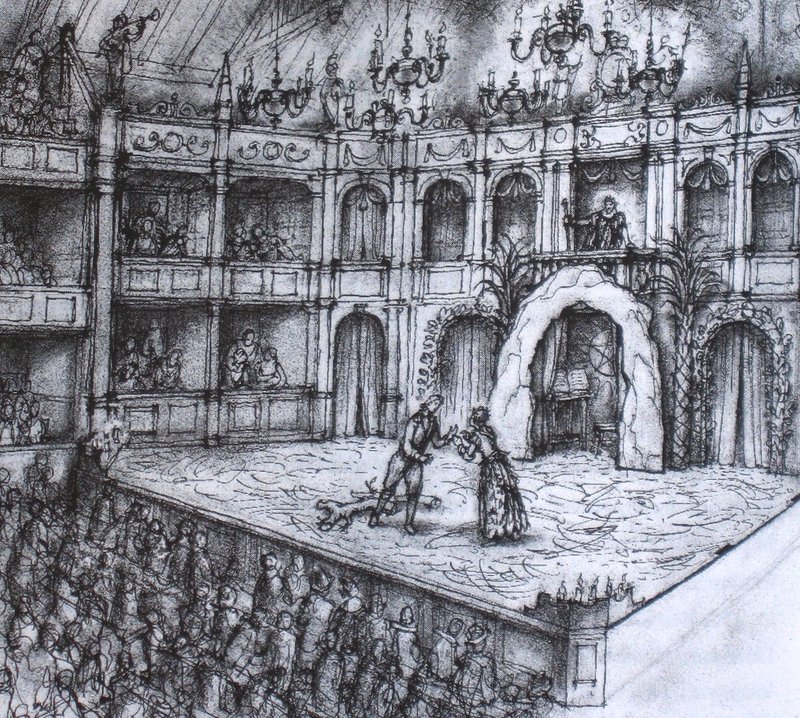
Image result for indoor theatre How were they different to outdoor playhouses?

  •  smaller than outdoor playhouses, holding about 500 people, not thousands. 
  •  built inside an existing building, so not open to the sky. 
  • more expensive (ranging from 6d to 2s and 6d), compared with open yard standing (at 1d) as in  outdoor playhouses. • lit by candles as well as daylight through the windows. (1d=1p)

Who acted in indoor playhouses?

Until 1609 the indoor theatres were used by boy companies and adult companies played at the outdoor playhouses.They were made up of boys of any age between seven and their early twenties. They usually played just once a week. 
The audience was thought to be more educated and richer than a outdoor one. Scholars used to think indoor theatre plays had more music, more more small, sparkly props such as jewels and pearls, and more speeches than action.

How did things change?

There were practical reasons why some plays were better suited to indoor theatres. Indoor theatres had a small stage. There were also stools allowed on the stage: the most expensive seats, where rich ‘gallants’ sat to be seen as well as to watch. 
the smaller space and the candlelight enhanced a play’s magical effects. Shakespeare wrote The Tempest with the Blackfriars theatre in mind, as well as A Winter’s Tale and Cymbeline.
The candles also mean that there had to be breaks for people to trim the candles, or replace the burnt out ones.

The Globe

The Globe

Image result for the globe theatreThe first Globe was built by the company Shakespeare and is funded and protected by the Lord Chamberlain and was called the Lord Chamberlain's men. Richard Burbage was the company’s leading actor.
They had played at the Theatre, built by the Burbage family on land leased from a Mr Allen. In 1597, Allen refused to renew the lease. However the Burbages owned the Theatre because the lease said they owned anything built on the land.
so they leased the land on south bank with Shakespeare

When and where was the globe built?

Southwark was a good place for the new theatre. It was outside the control of the city officials (who were disrespective to theatres). It had two theatres (the Rose and the Swan), animal baiting arenas, taverns and brothels. 
The base was brick and walls were made from timber frames with wood covered in plaster that were covered in cow hair 
1599 the theatre opened and was a huge success. 

What plays were performed in The Globe?

Probably the first Shakespeare play to be performed at the Globe was Julius Caesar, in 1599. Some other Shakespeare plays first performed there are: As You Like It; Hamlet; Measure for Measure;  Other playwrights wrote for the Globe, including Ben Jonson, Thomas Dekker and John Fletcher.


What happened to the first Globe?

1613. On 29 June, at a performance of Shakespeare’s Henry VIII, some small cannons were fired,
The theatre burned down in about an hour.he company built a second Globe on the brick foundations of the first. It was the same size and shape, but was much more extravagantly decorated; the company could now afford it. It also had a tiled roof, not a thatched one.


Actors


Actors

  • Actors got paid depending on the venue and cities  
  • The globe cast their actors specifically on their architypes 
  • Shakespeare would write roles for specific actors and the skills they have 
  • type casting 
  • most actors were all male until the 1660's
  • Plays would normally be performed in the afternoon because they needed natural light
  • they would never do the same play twice on one day 
  • actors never had the whole scipt
  • Shakespeare never saw his script published 

What was an actor's training?

  • Actors as young boys.
  • They would join a company as an apprentice and be taught by older actors within the company
  • Actors had to be able to: sing, dance, sword fight etc

How big were companies: 

  • How big the company is depends on how wealthy the company is 
  • A wealthy company, when working in a theatre, might have 8– 12 senior members called sharers, 3–4 boys, a number of hired actors and then stage hands, tiremen (who would help the actors dress back stage) and some musicians.

Where did a company work

  • Most company of actors lived and were based in London
  • Sometimes London Theatres were closed due to things like the plague during these times the company of actors would tour
  • Sometimes they would tour Germany and the Netherlands


The Language Of Shakespeare - 11/04/18

What we know about the period: 

  • Shakespeare's globe was also a way to gather news about the world and whats happening 
  • in Shakespeare's lifetime the world was expanding
  • Some of Shakespeares writing was equivocal: say one thing but mean another, you can see that in his writing
  • No one actually knows the true meaning of what he was trying to portray 
  • It was a tense political time because there was conflict between the protestants and catholics, however everyone was catholic but ones who don't follow the Italian pope, it was only after Henry the 8th died, protestant views and debates were brought in 
  • Shakespeare was born in the Elizabethan era
  • Slavery began in this period 
  • middle of the 19th century the British Empire was expanding and exploited a lot of other countries to bugger themselves
  • Time when piracy came and a lot of gold was discovered in lands like Spain and America


  • Shakespeare was born in the early modern period 
  • he was born in a transitional era from and agricultual to manufacturing 
  • Power balances were shifting the church was becoming separate from the state 
  • In the medieval state they were part of the holy roman empire 
  • new worlds were being discovered 
  • a new religious study were coming 
  • industries were being transferred form the monarchy to the state 
  • The ancient churches were painted and covered because before Henry the 8th they didn't understand the bible so they used bright pictures and statues, and the protestants wanted it to be translated to English so they could understand it and didn't need pictures
  • Renaissance period- often called the enlignment 
  • on Henrys death he thought he was a catholic they had 4 monachs, henrys son was a protestant and was brought up by his uncle who was a protestant.
  • Lady Jane Grey protestant was reigning for 9 days then executed by Mary the rightful heir and took the crown
  • Knows as Blood Mary because she killed many Protestants for practicing their faith then dies childless in 1558 
  • Elizabeth was then crowned queen and was very dedicated in keeping it safe she didn't like killing people, and said you couldn't die bu could be imprisoned and fined by practicing their protestant faith 
  • Shakespeare's dad was a catholic and if he didn't attend church he would get fined and he did get fined a lot, he went from being rich and part of the monarchy, however by the time he died he was poor due to the fines. 

Queen Lear Memory Video